
Matter42
ProductsTeamCareersDocsBlog
Sign in
ProductsTeamCareersDocsBlog
Sign in
Back to blog
VisionPublicAugust 20267 min read

Where does physics enter the AI system?

Six levels of integrating physics into AI systems, from a constraint layer that forbids impossible answers to an autonomous scientist that runs its own lab - the level where Physics AI hands off to Physical AI. Lets dive in with our friends Rick and Marvin

Both Physics AI and Physical AI are two of the most talked-about phrases in the field right now, and they are constantly mistaken for each other.

AI has a reputation for being brilliant and, occasionally, completely delusional. While a neural network model can predict the weather, fold a protein, or design a new material, it will also, just as readily, hand you an answer that violates the basic laws of the universe.

On the other hand, traditional physics simulations have the opposite problem. They respect the rules perfectly, but that fidelity comes at a brutal price: hours, days, or weeks per run, and a small fortune in computing power.

Physics AI is the art of getting the best of both worlds: the speed and pattern-spotting genius of AI, married to the ironclad reliability of physics. But "combining physics and AI" is not one thing. It is a spectrum. Physics can be whispered to a model as a gentle suggestion, or hard-wired into its bones so deeply that breaking the rules becomes mathematically impossible. It can be used to make AI faster, to make AI more trustworthy, or to hand AI the keys to an entire laboratory.

This article walks through that spectrum. As we climb, two things increase: how deeply physics is woven into the system, and how much we hand over to the AI.

To keep us company, the famously mad scientist Rick will narrate each breakthrough to Matter42's gloomy robot assistant, Marvin, who is never quite as impressed as Rick would like.
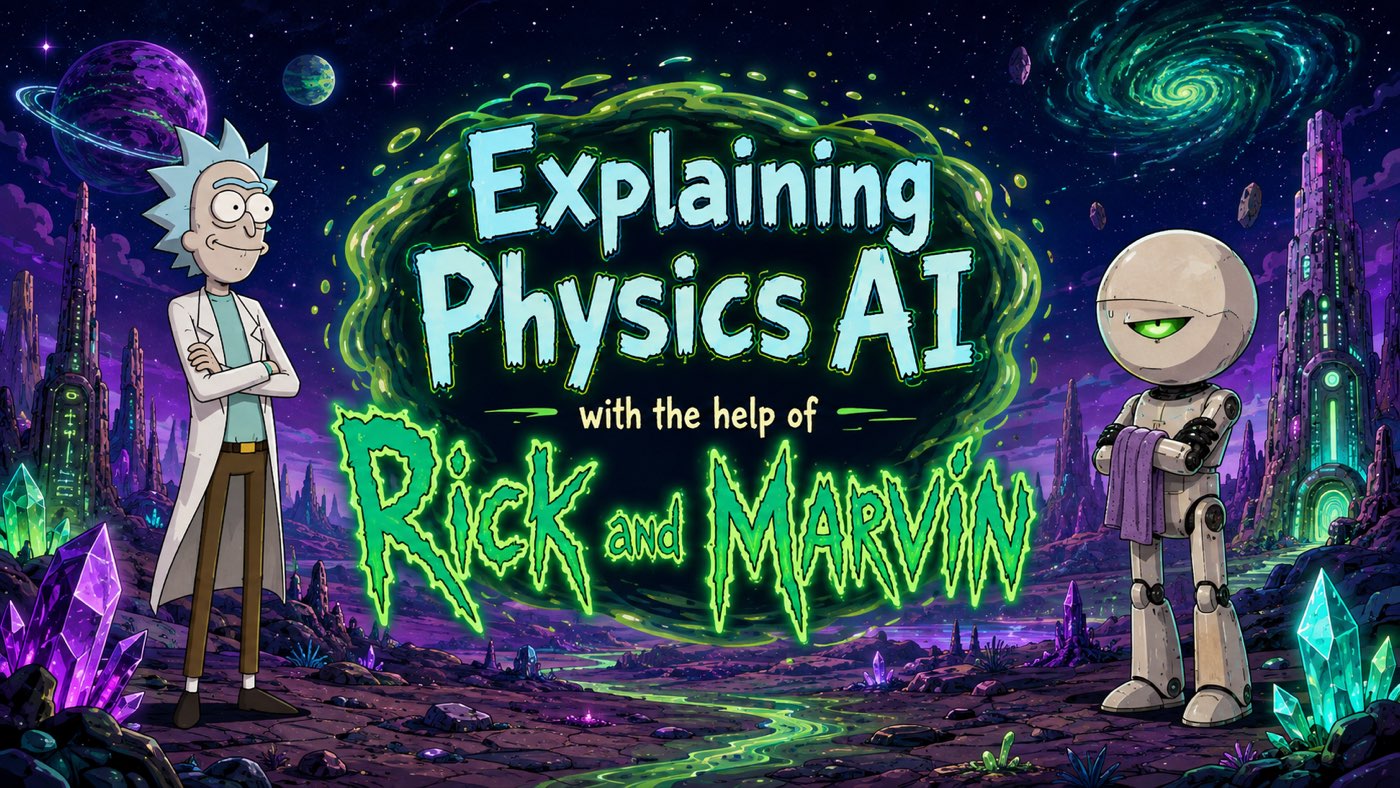
Comic banner: Rick and Marvin stand on a neon alien landscape beneath the title "Explaining Physics AI with the help of Rick and Marvin".

Phase One: Physics inside the model

Level 1: Physical constraints

The simplest way to keep an AI honest is to physically prevent it from giving impossible answers. You bolt a "constraint layer" onto the end of the model, a kind of mathematical bouncer that inspects every answer on the way out and refuses to let the impossible ones through.

Think of it as guardrails on a mountain road. The driver can steer however they like, but no matter what they do, the car simply cannot go off the cliff. If a quantity like density can never be negative in the real world, the constraint layer guarantees the model's output can never be negative either.

It is the least glamorous technique in the whole landscape, but it will never embarrass you by breaking a hard physical law.
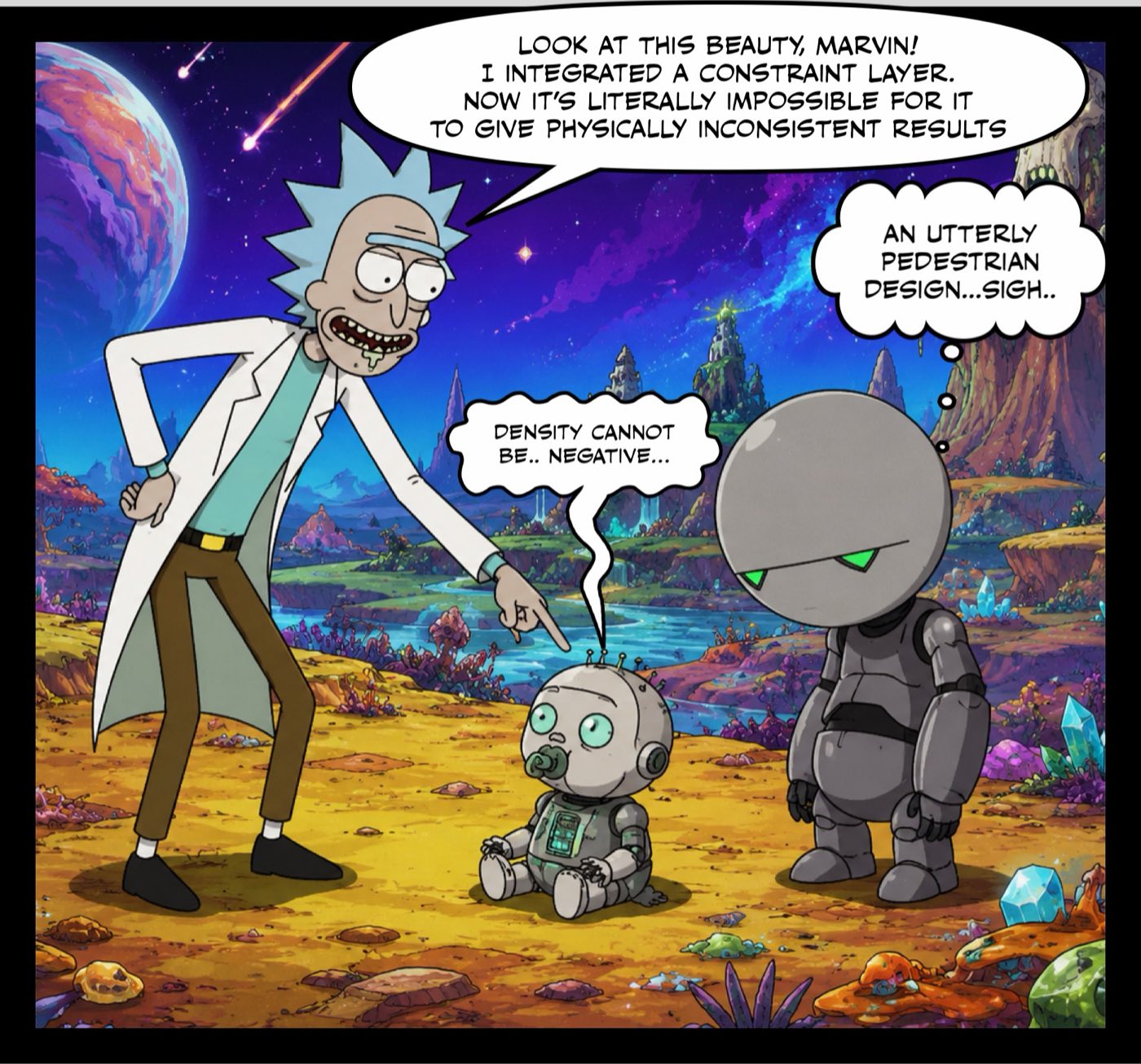
Comic panel: Rick points at a baby robot saying "density cannot be.. negative..." and boasts "I integrated a constraint layer. Now it's literally impossible for it to give physically inconsistent results." Marvin thinks: "an utterly pedestrian design...sigh.."

Level 2: Physics-informed training

Guardrails stop the worst outcomes, but they do not teach the model to understand physics. For that, we go one level deeper and put physics into how the model learns.

Every AI learns by being graded. It makes a guess, gets a score for how wrong it was, and adjusts to do better next time. That score is called the "loss function." At this level, we rewrite the grade so it does not just measure "did you match the data?" but also "did you obey the laws of physics?" Every time the model's answer violates a known equation, it loses points. To earn a good grade, it gradually learns to respect the rules on its own.

It is the difference between a bouncer and a strict teacher. The bouncer blocks the bad answers at the door. The teacher docks points every time the student breaks a rule, until respecting the rules becomes second nature. Models trained this way are often called PINNs (physics-informed neural networks).
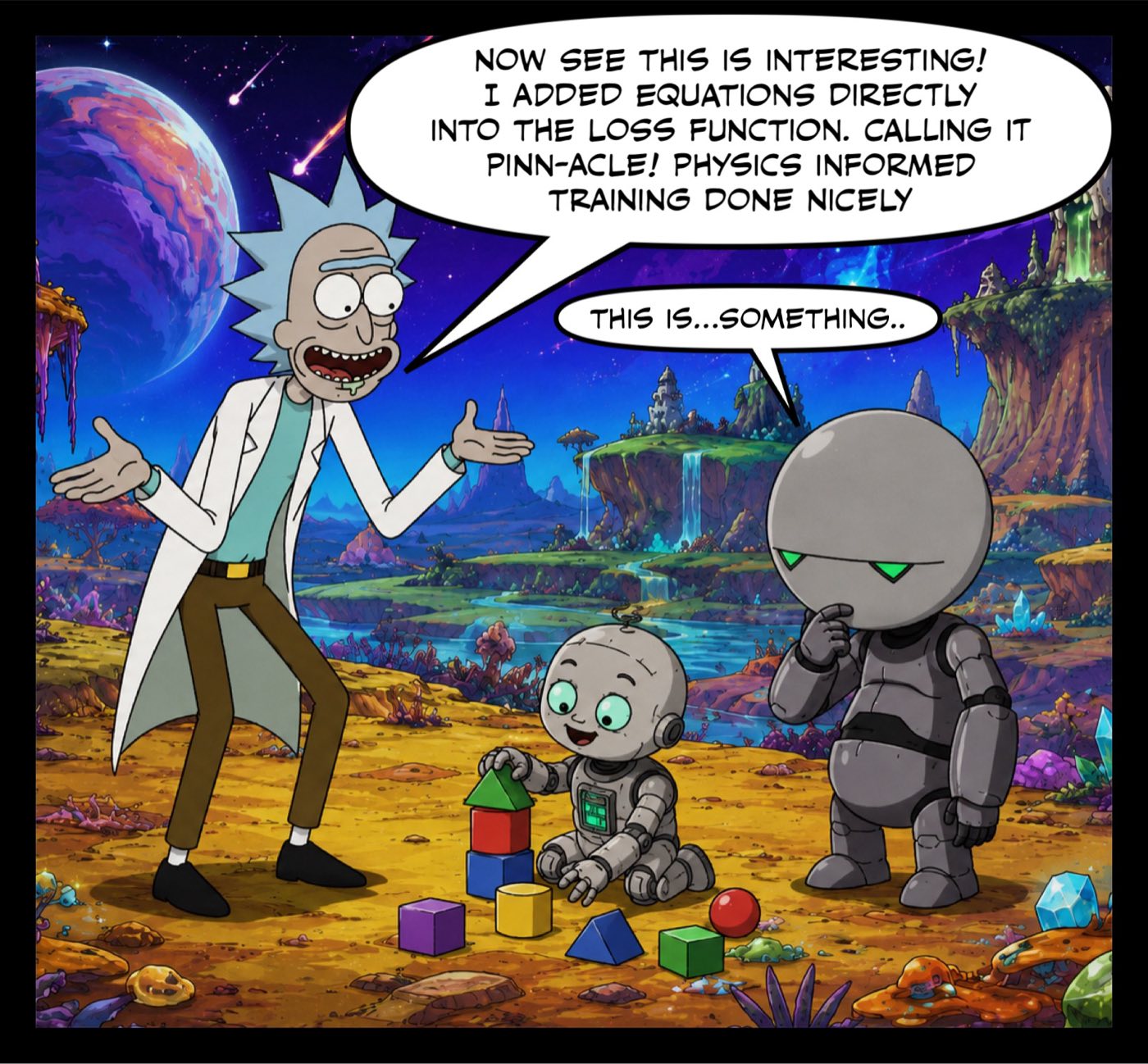
Comic panel: Rick, arms spread, announces "I added equations directly into the loss function. Calling it PINN-acle! Physics informed training done nicely." Marvin replies flatly: "This is...something.."

Level 3: Physics-aware architectures

At Level 2, we penalize the model for breaking the rules and hope it learns. At Level 3, we go further: we redesign the model so that certain physical truths are simply automatic. No penalty needed, because breaking the rule was never possible.

Here is a concrete example. Many laws of physics do not care about direction. The physics of a molecule is the same whether it points north or is spun around to point east. This property is called symmetry. Rather than making the model learn it from thousands of examples, we can build it directly into the model's structure, so that rotating the input automatically rotates the output, exactly as reality demands. The rule is not taught, it is merely a part of the machinery.

This is a more elegant design and often far more efficient, because the model does not waste effort relearning truths we already know.
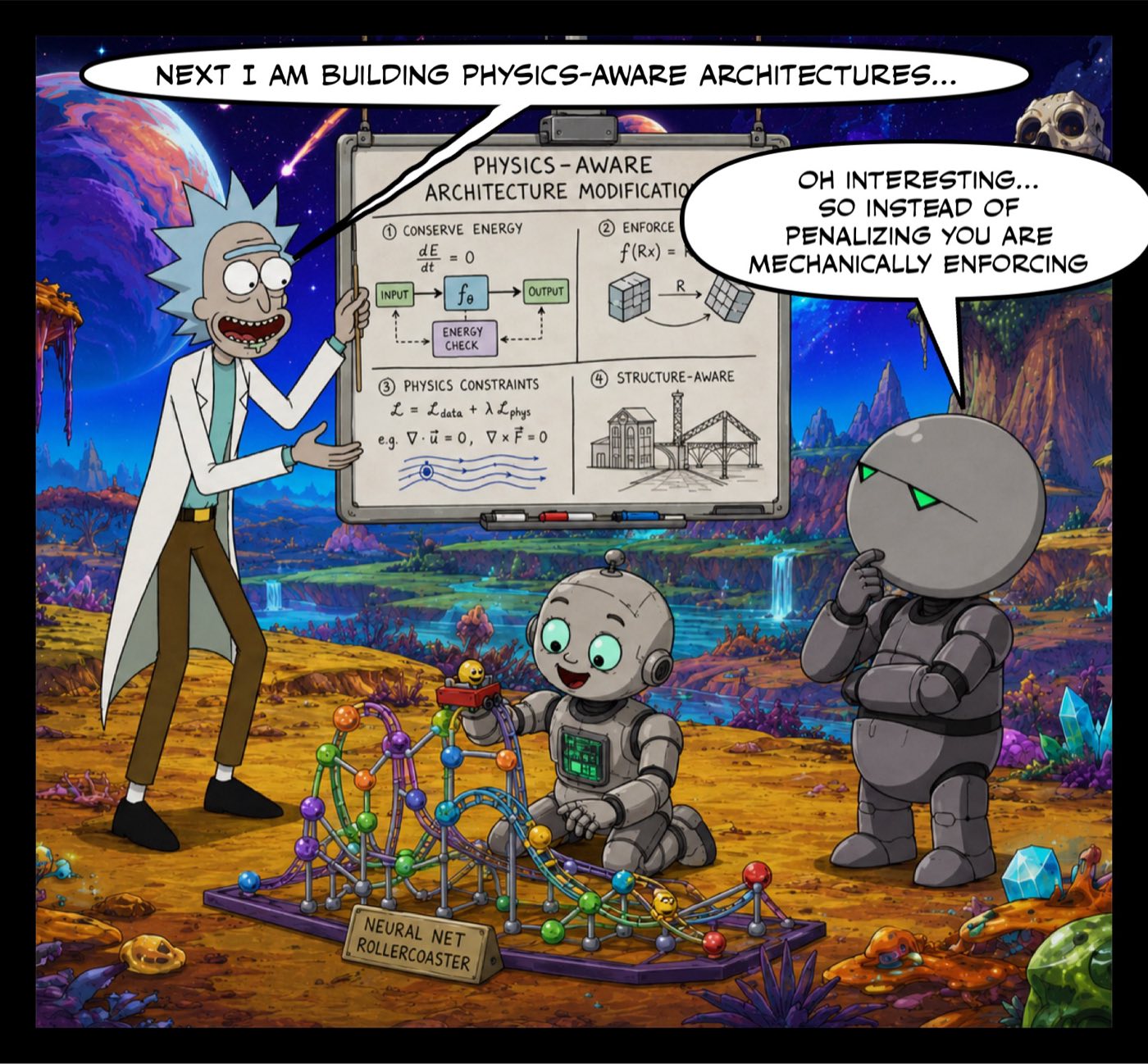
Comic panel: Rick presents a whiteboard titled "Physics-aware architecture modifications" listing energy conservation, equivariance, physics constraints and structure-aware design. Marvin observes: "Oh interesting... so instead of penalizing you are mechanically enforcing."

Phase Two: Physics and AI, working together

Level 4: AI surrogates

Some physics simulations are staggeringly expensive. Calculating how electrons behave in a material (a method called DFT - Density Functional Theory) or how air flows over a wing (CFD - Computational Fluid Dynamics) can tie up a supercomputer for hours per run. And, real research needs thousands of such runs.

The trick at this level is to train an AI to imitate the slow simulator. You run the expensive simulation many times, collect its results, and use that data to teach a neural network to reproduce the answers. The AI becomes a surrogate: a stand-in that produces nearly the same output in a fraction of the time.

The results in the field are dramatic. Tasks that once took hours can drop to milliseconds. This kind of acceleration does not just save time, it makes entirely new kinds of exploration possible.
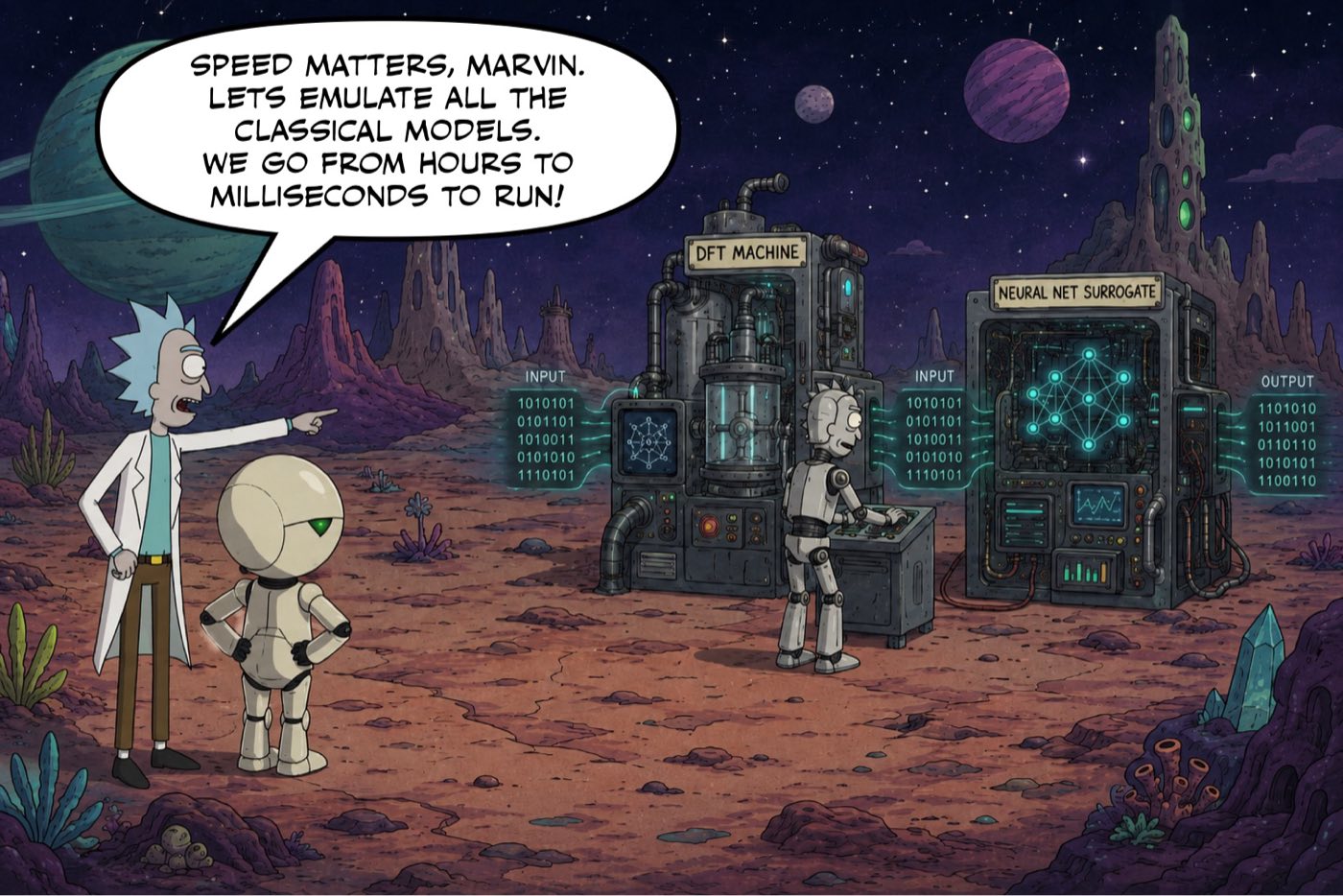
Comic panel: Rick gestures at a "DFT machine" feeding a "neural net surrogate" and says "Speed matters, Marvin. Let's emulate all the classical models. We go from hours to milliseconds to run!"

Level 5: Physics-in-the-loop

A surrogate is fast, but it is still just an imitator. And as we all know, at some point, imitators get exposed when they wander into territory they have never seen. Level 5 fixes this by putting the fast AI and the trustworthy simulator into a conversation.

The AI proposes promising ideas at high speed: a candidate material, an experimental design, a new molecule. The trusted physics simulator then checks the most interesting ones for real. Every verified result is fed back to the AI, which uses it to sharpen its next round of guesses. The loop tightens with each pass. The AI gets smarter, the search gets more focused, and the whole system homes in on good answers far faster than either piece could alone. This back-and-forth is often called active learning, and it powers techniques like inverse design, where you describe the properties you want and let the system search backward for something that delivers them.

It is like a bright student who keeps proposing experiments while an expert panel checks the work and teaches the student from each verified result. The student explores fearlessly; the experts keep it grounded in reality.
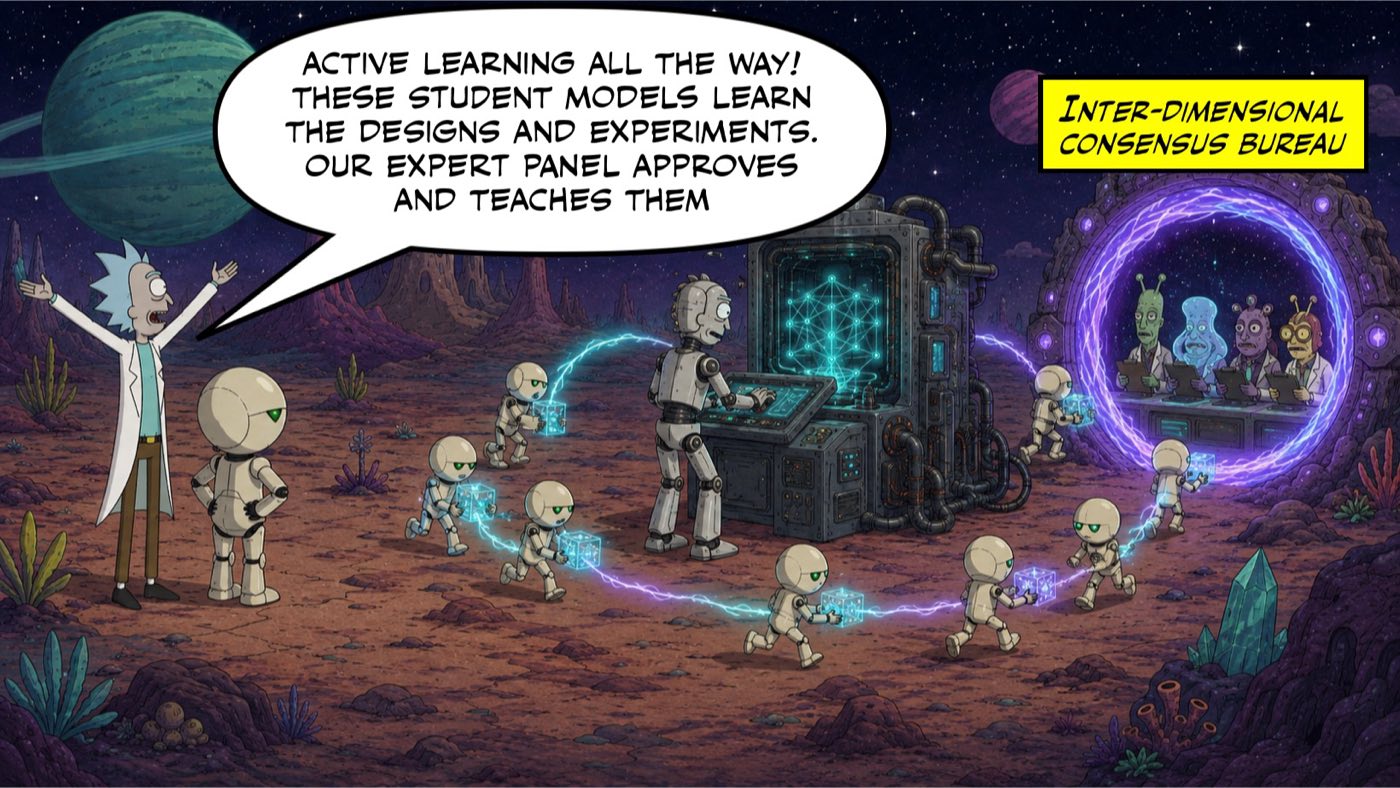
Comic panel: small student robots ferry glowing data cubes between a neural-net machine and an "inter-dimensional consensus bureau" of alien reviewers. Rick explains: "Active learning all the way! These student models learn the designs and experiments. Our expert panel approves and teaches them."

Phase Three: Handing over the keys to the lab

Level 6: The autonomous scientist

At the top of the ladder, we stop using AI as a tool inside a workflow and let it run the workflow. This is the autonomous scientist: an intelligent agent that manages the entire research loop end to end.

It reads the scientific literature to learn what is already known. It forms hypotheses, designs the experiments, launches and controls the simulations, analyzes the results and then, crucially, it decides what to try next and starts the whole cycle again, without a human driving each step.

Plan → Design → Simulate → Validate → Repeat, around the clock.

Every capability from the levels below (the fast surrogates, the verifying simulators, the physics-respecting models) becomes a tool this agent picks up and uses on its own initiative.

This is where the second term from the opening earns its place. Physics AI is what we have been building through all six levels: AI that knows the rules of the physical world. Physical AI is a different idea, it is the AI that acts in the physical world, through robots, instruments, and machines with moving parts.

For the first five levels the distinction does not matter, because everything happens in software. At Level 6 it starts to. An autonomous scientist that only runs simulations is a very fast theorist; it never touches a sample. Give it a robotic arm, an automated synthesis rig, and a characterization tool it can schedule, and it can run the experiment too.

That is where the two meet. The physics AI decides what is worth trying and what the result means, and the physical AI carries it out. Neither gets far alone. A brilliant hypothesis with no way to test it, or a very precise robot with no idea what to do next.

This is what researchers sometimes call the "self-driving lab," and it is the most ambitious vision in the field: not an AI that helps scientists, but an AI that does science.
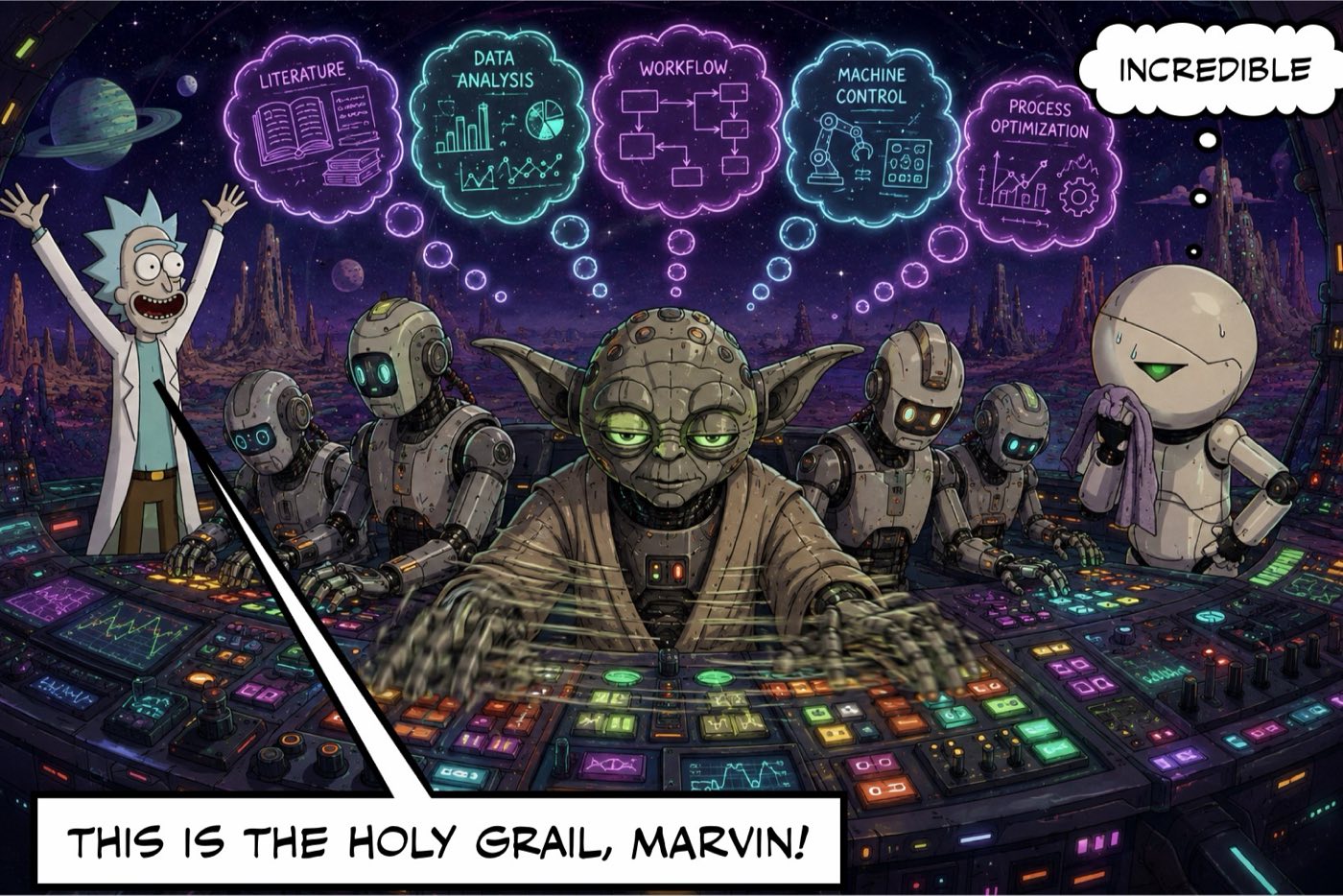
Comic panel: a crowded starship console run by robots, with thought bubbles for literature, data analysis, workflow, machine control and process optimization. Rick throws his arms up — "This is the holy grail, Marvin!" — and Marvin finally admits: "Incredible."

Finally, our Marvin is impressed.


The comics in this post were made jointly by Matter42's Chief Comic Officer and an AI. Between them they have one AI degree, zero art degrees, and one shared conviction that Marvin should look sadder.

Matter42

Automated analysis and decision support for thin film and 2D semiconductor characterization.

ProductsTeamCareersDocsBlog
LinkedInPrivacy PolicyTerms and Conditions

Copyright © 2026 Matter42. All rights reserved.

Matter42
ProductsTeamCareersDocsBlog
Sign in
ProductsTeamCareersDocsBlog
Sign in
Back to blog
VisionPublicAugust 20267 min read

Where does physics enter the AI system?

Six levels of integrating physics into AI systems, from a constraint layer that forbids impossible answers to an autonomous scientist that runs its own lab - the level where Physics AI hands off to Physical AI. Lets dive in with our friends Rick and Marvin

Both Physics AI and Physical AI are two of the most talked-about phrases in the field right now, and they are constantly mistaken for each other.

AI has a reputation for being brilliant and, occasionally, completely delusional. While a neural network model can predict the weather, fold a protein, or design a new material, it will also, just as readily, hand you an answer that violates the basic laws of the universe.

On the other hand, traditional physics simulations have the opposite problem. They respect the rules perfectly, but that fidelity comes at a brutal price: hours, days, or weeks per run, and a small fortune in computing power.

Physics AI is the art of getting the best of both worlds: the speed and pattern-spotting genius of AI, married to the ironclad reliability of physics. But "combining physics and AI" is not one thing. It is a spectrum. Physics can be whispered to a model as a gentle suggestion, or hard-wired into its bones so deeply that breaking the rules becomes mathematically impossible. It can be used to make AI faster, to make AI more trustworthy, or to hand AI the keys to an entire laboratory.

This article walks through that spectrum. As we climb, two things increase: how deeply physics is woven into the system, and how much we hand over to the AI.

To keep us company, the famously mad scientist Rick will narrate each breakthrough to Matter42's gloomy robot assistant, Marvin, who is never quite as impressed as Rick would like.

Comic banner: Rick and Marvin stand on a neon alien landscape beneath the title "Explaining Physics AI with the help of Rick and Marvin".

Phase One: Physics inside the model

Level 1: Physical constraints

The simplest way to keep an AI honest is to physically prevent it from giving impossible answers. You bolt a "constraint layer" onto the end of the model, a kind of mathematical bouncer that inspects every answer on the way out and refuses to let the impossible ones through.

Think of it as guardrails on a mountain road. The driver can steer however they like, but no matter what they do, the car simply cannot go off the cliff. If a quantity like density can never be negative in the real world, the constraint layer guarantees the model's output can never be negative either.

It is the least glamorous technique in the whole landscape, but it will never embarrass you by breaking a hard physical law.

Comic panel: Rick points at a baby robot saying "density cannot be.. negative..." and boasts "I integrated a constraint layer. Now it's literally impossible for it to give physically inconsistent results." Marvin thinks: "an utterly pedestrian design...sigh.."

Level 2: Physics-informed training

Guardrails stop the worst outcomes, but they do not teach the model to understand physics. For that, we go one level deeper and put physics into how the model learns.

Every AI learns by being graded. It makes a guess, gets a score for how wrong it was, and adjusts to do better next time. That score is called the "loss function." At this level, we rewrite the grade so it does not just measure "did you match the data?" but also "did you obey the laws of physics?" Every time the model's answer violates a known equation, it loses points. To earn a good grade, it gradually learns to respect the rules on its own.

It is the difference between a bouncer and a strict teacher. The bouncer blocks the bad answers at the door. The teacher docks points every time the student breaks a rule, until respecting the rules becomes second nature. Models trained this way are often called PINNs (physics-informed neural networks).

Comic panel: Rick, arms spread, announces "I added equations directly into the loss function. Calling it PINN-acle! Physics informed training done nicely." Marvin replies flatly: "This is...something.."

Level 3: Physics-aware architectures

At Level 2, we penalize the model for breaking the rules and hope it learns. At Level 3, we go further: we redesign the model so that certain physical truths are simply automatic. No penalty needed, because breaking the rule was never possible.

Here is a concrete example. Many laws of physics do not care about direction. The physics of a molecule is the same whether it points north or is spun around to point east. This property is called symmetry. Rather than making the model learn it from thousands of examples, we can build it directly into the model's structure, so that rotating the input automatically rotates the output, exactly as reality demands. The rule is not taught, it is merely a part of the machinery.

This is a more elegant design and often far more efficient, because the model does not waste effort relearning truths we already know.

Comic panel: Rick presents a whiteboard titled "Physics-aware architecture modifications" listing energy conservation, equivariance, physics constraints and structure-aware design. Marvin observes: "Oh interesting... so instead of penalizing you are mechanically enforcing."

Phase Two: Physics and AI, working together

Level 4: AI surrogates

Some physics simulations are staggeringly expensive. Calculating how electrons behave in a material (a method called DFT - Density Functional Theory) or how air flows over a wing (CFD - Computational Fluid Dynamics) can tie up a supercomputer for hours per run. And, real research needs thousands of such runs.

The trick at this level is to train an AI to imitate the slow simulator. You run the expensive simulation many times, collect its results, and use that data to teach a neural network to reproduce the answers. The AI becomes a surrogate: a stand-in that produces nearly the same output in a fraction of the time.

The results in the field are dramatic. Tasks that once took hours can drop to milliseconds. This kind of acceleration does not just save time, it makes entirely new kinds of exploration possible.

Comic panel: Rick gestures at a "DFT machine" feeding a "neural net surrogate" and says "Speed matters, Marvin. Let's emulate all the classical models. We go from hours to milliseconds to run!"

Level 5: Physics-in-the-loop

A surrogate is fast, but it is still just an imitator. And as we all know, at some point, imitators get exposed when they wander into territory they have never seen. Level 5 fixes this by putting the fast AI and the trustworthy simulator into a conversation.

The AI proposes promising ideas at high speed: a candidate material, an experimental design, a new molecule. The trusted physics simulator then checks the most interesting ones for real. Every verified result is fed back to the AI, which uses it to sharpen its next round of guesses. The loop tightens with each pass. The AI gets smarter, the search gets more focused, and the whole system homes in on good answers far faster than either piece could alone. This back-and-forth is often called active learning, and it powers techniques like inverse design, where you describe the properties you want and let the system search backward for something that delivers them.

It is like a bright student who keeps proposing experiments while an expert panel checks the work and teaches the student from each verified result. The student explores fearlessly; the experts keep it grounded in reality.

Comic panel: small student robots ferry glowing data cubes between a neural-net machine and an "inter-dimensional consensus bureau" of alien reviewers. Rick explains: "Active learning all the way! These student models learn the designs and experiments. Our expert panel approves and teaches them."

Phase Three: Handing over the keys to the lab

Level 6: The autonomous scientist

At the top of the ladder, we stop using AI as a tool inside a workflow and let it run the workflow. This is the autonomous scientist: an intelligent agent that manages the entire research loop end to end.

It reads the scientific literature to learn what is already known. It forms hypotheses, designs the experiments, launches and controls the simulations, analyzes the results and then, crucially, it decides what to try next and starts the whole cycle again, without a human driving each step.

Plan → Design → Simulate → Validate → Repeat, around the clock.

Every capability from the levels below (the fast surrogates, the verifying simulators, the physics-respecting models) becomes a tool this agent picks up and uses on its own initiative.

This is where the second term from the opening earns its place. Physics AI is what we have been building through all six levels: AI that knows the rules of the physical world. Physical AI is a different idea, it is the AI that acts in the physical world, through robots, instruments, and machines with moving parts.

For the first five levels the distinction does not matter, because everything happens in software. At Level 6 it starts to. An autonomous scientist that only runs simulations is a very fast theorist; it never touches a sample. Give it a robotic arm, an automated synthesis rig, and a characterization tool it can schedule, and it can run the experiment too.

That is where the two meet. The physics AI decides what is worth trying and what the result means, and the physical AI carries it out. Neither gets far alone. A brilliant hypothesis with no way to test it, or a very precise robot with no idea what to do next.

This is what researchers sometimes call the "self-driving lab," and it is the most ambitious vision in the field: not an AI that helps scientists, but an AI that does science.

Comic panel: a crowded starship console run by robots, with thought bubbles for literature, data analysis, workflow, machine control and process optimization. Rick throws his arms up — "This is the holy grail, Marvin!" — and Marvin finally admits: "Incredible."

Finally, our Marvin is impressed.


The comics in this post were made jointly by Matter42's Chief Comic Officer and an AI. Between them they have one AI degree, zero art degrees, and one shared conviction that Marvin should look sadder.

Matter42

Automated analysis and decision support for thin film and 2D semiconductor characterization.

ProductsTeamCareersDocsBlog
LinkedInPrivacy PolicyTerms and Conditions

Copyright © 2026 Matter42. All rights reserved.

Matter42
ProductsTeamCareersDocsBlog
Sign in
ProductsTeamCareersDocsBlog
Sign in
Back to blog
VisionPublicAugust 20267 min read

Where does physics enter the AI system?

Six levels of integrating physics into AI systems, from a constraint layer that forbids impossible answers to an autonomous scientist that runs its own lab - the level where Physics AI hands off to Physical AI. Lets dive in with our friends Rick and Marvin

Both Physics AI and Physical AI are two of the most talked-about phrases in the field right now, and they are constantly mistaken for each other.

AI has a reputation for being brilliant and, occasionally, completely delusional. While a neural network model can predict the weather, fold a protein, or design a new material, it will also, just as readily, hand you an answer that violates the basic laws of the universe.

On the other hand, traditional physics simulations have the opposite problem. They respect the rules perfectly, but that fidelity comes at a brutal price: hours, days, or weeks per run, and a small fortune in computing power.

Physics AI is the art of getting the best of both worlds: the speed and pattern-spotting genius of AI, married to the ironclad reliability of physics. But "combining physics and AI" is not one thing. It is a spectrum. Physics can be whispered to a model as a gentle suggestion, or hard-wired into its bones so deeply that breaking the rules becomes mathematically impossible. It can be used to make AI faster, to make AI more trustworthy, or to hand AI the keys to an entire laboratory.

This article walks through that spectrum. As we climb, two things increase: how deeply physics is woven into the system, and how much we hand over to the AI.

To keep us company, the famously mad scientist Rick will narrate each breakthrough to Matter42's gloomy robot assistant, Marvin, who is never quite as impressed as Rick would like.

Comic banner: Rick and Marvin stand on a neon alien landscape beneath the title "Explaining Physics AI with the help of Rick and Marvin".

Phase One: Physics inside the model

Level 1: Physical constraints

The simplest way to keep an AI honest is to physically prevent it from giving impossible answers. You bolt a "constraint layer" onto the end of the model, a kind of mathematical bouncer that inspects every answer on the way out and refuses to let the impossible ones through.

Think of it as guardrails on a mountain road. The driver can steer however they like, but no matter what they do, the car simply cannot go off the cliff. If a quantity like density can never be negative in the real world, the constraint layer guarantees the model's output can never be negative either.

It is the least glamorous technique in the whole landscape, but it will never embarrass you by breaking a hard physical law.

Comic panel: Rick points at a baby robot saying "density cannot be.. negative..." and boasts "I integrated a constraint layer. Now it's literally impossible for it to give physically inconsistent results." Marvin thinks: "an utterly pedestrian design...sigh.."

Level 2: Physics-informed training

Guardrails stop the worst outcomes, but they do not teach the model to understand physics. For that, we go one level deeper and put physics into how the model learns.

Every AI learns by being graded. It makes a guess, gets a score for how wrong it was, and adjusts to do better next time. That score is called the "loss function." At this level, we rewrite the grade so it does not just measure "did you match the data?" but also "did you obey the laws of physics?" Every time the model's answer violates a known equation, it loses points. To earn a good grade, it gradually learns to respect the rules on its own.

It is the difference between a bouncer and a strict teacher. The bouncer blocks the bad answers at the door. The teacher docks points every time the student breaks a rule, until respecting the rules becomes second nature. Models trained this way are often called PINNs (physics-informed neural networks).

Comic panel: Rick, arms spread, announces "I added equations directly into the loss function. Calling it PINN-acle! Physics informed training done nicely." Marvin replies flatly: "This is...something.."

Level 3: Physics-aware architectures

At Level 2, we penalize the model for breaking the rules and hope it learns. At Level 3, we go further: we redesign the model so that certain physical truths are simply automatic. No penalty needed, because breaking the rule was never possible.

Here is a concrete example. Many laws of physics do not care about direction. The physics of a molecule is the same whether it points north or is spun around to point east. This property is called symmetry. Rather than making the model learn it from thousands of examples, we can build it directly into the model's structure, so that rotating the input automatically rotates the output, exactly as reality demands. The rule is not taught, it is merely a part of the machinery.

This is a more elegant design and often far more efficient, because the model does not waste effort relearning truths we already know.

Comic panel: Rick presents a whiteboard titled "Physics-aware architecture modifications" listing energy conservation, equivariance, physics constraints and structure-aware design. Marvin observes: "Oh interesting... so instead of penalizing you are mechanically enforcing."

Phase Two: Physics and AI, working together

Level 4: AI surrogates

Some physics simulations are staggeringly expensive. Calculating how electrons behave in a material (a method called DFT - Density Functional Theory) or how air flows over a wing (CFD - Computational Fluid Dynamics) can tie up a supercomputer for hours per run. And, real research needs thousands of such runs.

The trick at this level is to train an AI to imitate the slow simulator. You run the expensive simulation many times, collect its results, and use that data to teach a neural network to reproduce the answers. The AI becomes a surrogate: a stand-in that produces nearly the same output in a fraction of the time.

The results in the field are dramatic. Tasks that once took hours can drop to milliseconds. This kind of acceleration does not just save time, it makes entirely new kinds of exploration possible.

Comic panel: Rick gestures at a "DFT machine" feeding a "neural net surrogate" and says "Speed matters, Marvin. Let's emulate all the classical models. We go from hours to milliseconds to run!"

Level 5: Physics-in-the-loop

A surrogate is fast, but it is still just an imitator. And as we all know, at some point, imitators get exposed when they wander into territory they have never seen. Level 5 fixes this by putting the fast AI and the trustworthy simulator into a conversation.

The AI proposes promising ideas at high speed: a candidate material, an experimental design, a new molecule. The trusted physics simulator then checks the most interesting ones for real. Every verified result is fed back to the AI, which uses it to sharpen its next round of guesses. The loop tightens with each pass. The AI gets smarter, the search gets more focused, and the whole system homes in on good answers far faster than either piece could alone. This back-and-forth is often called active learning, and it powers techniques like inverse design, where you describe the properties you want and let the system search backward for something that delivers them.

It is like a bright student who keeps proposing experiments while an expert panel checks the work and teaches the student from each verified result. The student explores fearlessly; the experts keep it grounded in reality.

Comic panel: small student robots ferry glowing data cubes between a neural-net machine and an "inter-dimensional consensus bureau" of alien reviewers. Rick explains: "Active learning all the way! These student models learn the designs and experiments. Our expert panel approves and teaches them."

Phase Three: Handing over the keys to the lab

Level 6: The autonomous scientist

At the top of the ladder, we stop using AI as a tool inside a workflow and let it run the workflow. This is the autonomous scientist: an intelligent agent that manages the entire research loop end to end.

It reads the scientific literature to learn what is already known. It forms hypotheses, designs the experiments, launches and controls the simulations, analyzes the results and then, crucially, it decides what to try next and starts the whole cycle again, without a human driving each step.

Plan → Design → Simulate → Validate → Repeat, around the clock.

Every capability from the levels below (the fast surrogates, the verifying simulators, the physics-respecting models) becomes a tool this agent picks up and uses on its own initiative.

This is where the second term from the opening earns its place. Physics AI is what we have been building through all six levels: AI that knows the rules of the physical world. Physical AI is a different idea, it is the AI that acts in the physical world, through robots, instruments, and machines with moving parts.

For the first five levels the distinction does not matter, because everything happens in software. At Level 6 it starts to. An autonomous scientist that only runs simulations is a very fast theorist; it never touches a sample. Give it a robotic arm, an automated synthesis rig, and a characterization tool it can schedule, and it can run the experiment too.

That is where the two meet. The physics AI decides what is worth trying and what the result means, and the physical AI carries it out. Neither gets far alone. A brilliant hypothesis with no way to test it, or a very precise robot with no idea what to do next.

This is what researchers sometimes call the "self-driving lab," and it is the most ambitious vision in the field: not an AI that helps scientists, but an AI that does science.

Comic panel: a crowded starship console run by robots, with thought bubbles for literature, data analysis, workflow, machine control and process optimization. Rick throws his arms up — "This is the holy grail, Marvin!" — and Marvin finally admits: "Incredible."

Finally, our Marvin is impressed.


The comics in this post were made jointly by Matter42's Chief Comic Officer and an AI. Between them they have one AI degree, zero art degrees, and one shared conviction that Marvin should look sadder.

Matter42

Automated analysis and decision support for thin film and 2D semiconductor characterization.

ProductsTeamCareersDocsBlog
LinkedInPrivacy PolicyTerms and Conditions

Copyright © 2026 Matter42. All rights reserved.

Matter42
ProductsTeamCareersDocsBlog
Sign in
ProductsTeamCareersDocsBlog
Sign in
Back to blog
VisionPublicAugust 20267 min read

Where does physics enter the AI system?

Six levels of integrating physics into AI systems, from a constraint layer that forbids impossible answers to an autonomous scientist that runs its own lab - the level where Physics AI hands off to Physical AI. Lets dive in with our friends Rick and Marvin

Both Physics AI and Physical AI are two of the most talked-about phrases in the field right now, and they are constantly mistaken for each other.

AI has a reputation for being brilliant and, occasionally, completely delusional. While a neural network model can predict the weather, fold a protein, or design a new material, it will also, just as readily, hand you an answer that violates the basic laws of the universe.

On the other hand, traditional physics simulations have the opposite problem. They respect the rules perfectly, but that fidelity comes at a brutal price: hours, days, or weeks per run, and a small fortune in computing power.

Physics AI is the art of getting the best of both worlds: the speed and pattern-spotting genius of AI, married to the ironclad reliability of physics. But "combining physics and AI" is not one thing. It is a spectrum. Physics can be whispered to a model as a gentle suggestion, or hard-wired into its bones so deeply that breaking the rules becomes mathematically impossible. It can be used to make AI faster, to make AI more trustworthy, or to hand AI the keys to an entire laboratory.

This article walks through that spectrum. As we climb, two things increase: how deeply physics is woven into the system, and how much we hand over to the AI.

To keep us company, the famously mad scientist Rick will narrate each breakthrough to Matter42's gloomy robot assistant, Marvin, who is never quite as impressed as Rick would like.

Comic banner: Rick and Marvin stand on a neon alien landscape beneath the title "Explaining Physics AI with the help of Rick and Marvin".

Phase One: Physics inside the model

Level 1: Physical constraints

The simplest way to keep an AI honest is to physically prevent it from giving impossible answers. You bolt a "constraint layer" onto the end of the model, a kind of mathematical bouncer that inspects every answer on the way out and refuses to let the impossible ones through.

Think of it as guardrails on a mountain road. The driver can steer however they like, but no matter what they do, the car simply cannot go off the cliff. If a quantity like density can never be negative in the real world, the constraint layer guarantees the model's output can never be negative either.

It is the least glamorous technique in the whole landscape, but it will never embarrass you by breaking a hard physical law.

Comic panel: Rick points at a baby robot saying "density cannot be.. negative..." and boasts "I integrated a constraint layer. Now it's literally impossible for it to give physically inconsistent results." Marvin thinks: "an utterly pedestrian design...sigh.."

Level 2: Physics-informed training

Guardrails stop the worst outcomes, but they do not teach the model to understand physics. For that, we go one level deeper and put physics into how the model learns.

Every AI learns by being graded. It makes a guess, gets a score for how wrong it was, and adjusts to do better next time. That score is called the "loss function." At this level, we rewrite the grade so it does not just measure "did you match the data?" but also "did you obey the laws of physics?" Every time the model's answer violates a known equation, it loses points. To earn a good grade, it gradually learns to respect the rules on its own.

It is the difference between a bouncer and a strict teacher. The bouncer blocks the bad answers at the door. The teacher docks points every time the student breaks a rule, until respecting the rules becomes second nature. Models trained this way are often called PINNs (physics-informed neural networks).

Comic panel: Rick, arms spread, announces "I added equations directly into the loss function. Calling it PINN-acle! Physics informed training done nicely." Marvin replies flatly: "This is...something.."

Level 3: Physics-aware architectures

At Level 2, we penalize the model for breaking the rules and hope it learns. At Level 3, we go further: we redesign the model so that certain physical truths are simply automatic. No penalty needed, because breaking the rule was never possible.

Here is a concrete example. Many laws of physics do not care about direction. The physics of a molecule is the same whether it points north or is spun around to point east. This property is called symmetry. Rather than making the model learn it from thousands of examples, we can build it directly into the model's structure, so that rotating the input automatically rotates the output, exactly as reality demands. The rule is not taught, it is merely a part of the machinery.

This is a more elegant design and often far more efficient, because the model does not waste effort relearning truths we already know.

Comic panel: Rick presents a whiteboard titled "Physics-aware architecture modifications" listing energy conservation, equivariance, physics constraints and structure-aware design. Marvin observes: "Oh interesting... so instead of penalizing you are mechanically enforcing."

Phase Two: Physics and AI, working together

Level 4: AI surrogates

Some physics simulations are staggeringly expensive. Calculating how electrons behave in a material (a method called DFT - Density Functional Theory) or how air flows over a wing (CFD - Computational Fluid Dynamics) can tie up a supercomputer for hours per run. And, real research needs thousands of such runs.

The trick at this level is to train an AI to imitate the slow simulator. You run the expensive simulation many times, collect its results, and use that data to teach a neural network to reproduce the answers. The AI becomes a surrogate: a stand-in that produces nearly the same output in a fraction of the time.

The results in the field are dramatic. Tasks that once took hours can drop to milliseconds. This kind of acceleration does not just save time, it makes entirely new kinds of exploration possible.

Comic panel: Rick gestures at a "DFT machine" feeding a "neural net surrogate" and says "Speed matters, Marvin. Let's emulate all the classical models. We go from hours to milliseconds to run!"

Level 5: Physics-in-the-loop

A surrogate is fast, but it is still just an imitator. And as we all know, at some point, imitators get exposed when they wander into territory they have never seen. Level 5 fixes this by putting the fast AI and the trustworthy simulator into a conversation.

The AI proposes promising ideas at high speed: a candidate material, an experimental design, a new molecule. The trusted physics simulator then checks the most interesting ones for real. Every verified result is fed back to the AI, which uses it to sharpen its next round of guesses. The loop tightens with each pass. The AI gets smarter, the search gets more focused, and the whole system homes in on good answers far faster than either piece could alone. This back-and-forth is often called active learning, and it powers techniques like inverse design, where you describe the properties you want and let the system search backward for something that delivers them.

It is like a bright student who keeps proposing experiments while an expert panel checks the work and teaches the student from each verified result. The student explores fearlessly; the experts keep it grounded in reality.

Comic panel: small student robots ferry glowing data cubes between a neural-net machine and an "inter-dimensional consensus bureau" of alien reviewers. Rick explains: "Active learning all the way! These student models learn the designs and experiments. Our expert panel approves and teaches them."

Phase Three: Handing over the keys to the lab

Level 6: The autonomous scientist

At the top of the ladder, we stop using AI as a tool inside a workflow and let it run the workflow. This is the autonomous scientist: an intelligent agent that manages the entire research loop end to end.

It reads the scientific literature to learn what is already known. It forms hypotheses, designs the experiments, launches and controls the simulations, analyzes the results and then, crucially, it decides what to try next and starts the whole cycle again, without a human driving each step.

Plan → Design → Simulate → Validate → Repeat, around the clock.

Every capability from the levels below (the fast surrogates, the verifying simulators, the physics-respecting models) becomes a tool this agent picks up and uses on its own initiative.

This is where the second term from the opening earns its place. Physics AI is what we have been building through all six levels: AI that knows the rules of the physical world. Physical AI is a different idea, it is the AI that acts in the physical world, through robots, instruments, and machines with moving parts.

For the first five levels the distinction does not matter, because everything happens in software. At Level 6 it starts to. An autonomous scientist that only runs simulations is a very fast theorist; it never touches a sample. Give it a robotic arm, an automated synthesis rig, and a characterization tool it can schedule, and it can run the experiment too.

That is where the two meet. The physics AI decides what is worth trying and what the result means, and the physical AI carries it out. Neither gets far alone. A brilliant hypothesis with no way to test it, or a very precise robot with no idea what to do next.

This is what researchers sometimes call the "self-driving lab," and it is the most ambitious vision in the field: not an AI that helps scientists, but an AI that does science.

Comic panel: a crowded starship console run by robots, with thought bubbles for literature, data analysis, workflow, machine control and process optimization. Rick throws his arms up — "This is the holy grail, Marvin!" — and Marvin finally admits: "Incredible."

Finally, our Marvin is impressed.


The comics in this post were made jointly by Matter42's Chief Comic Officer and an AI. Between them they have one AI degree, zero art degrees, and one shared conviction that Marvin should look sadder.

Matter42

Automated analysis and decision support for thin film and 2D semiconductor characterization.

ProductsTeamCareersDocsBlog
LinkedInPrivacy PolicyTerms and Conditions

Copyright © 2026 Matter42. All rights reserved.